Showing posts with label aging population. Show all posts

Read: What is So Good About Growing Old

Tuesday, 10 June 2014

What is So Good About Growing Old 
Forget about senior moments. The great news is that researchers are discovering some surprising advantages of aging 

By Helen Fields Smithsonian Magazine | July 2012
Even as certain mental skills decline with age—what was that guy’s name again?—scientists are finding the mind gets sharper at a number of vitally important abilities. In a University of Illinois study, older air traffic controllers excelled at their cognitively taxing jobs, despite some losses in short-term memory and visual spatial processing. How so? They were expert at navigating, juggling multiple aircraft simultaneously and avoiding collisions.
People also learn how to deal with social conflicts more effectively. For a 2010 study, researchers at the University of Michigan presented “Dear Abby” letters to 200 people and asked what advice they would give. Subjects in their 60s were better than younger ones at imagining different points of view, thinking of multiple resolutions and suggesting compromises.
It turns out that managing emotions is a skill in itself, one that takes many of us decades to master. For a study published this year, German researchers had people play a gambling game meant to induce regret. Unlike 20-somethings, those in their 60s didn’t agonize over losing, and they were less likely to try to redeem their loss by later taking big risks.
These social skills may bring huge benefits. In 2010, researchers at Stony Brook University analyzed a telephone survey of hundreds of thousands of Americans and found that people over 50 were happier overall, with anger declining steadily from the 20s through the 70s and stress falling off a cliff in the 50s.
This may be news to people who equate being old with being sad and alone, but it fits with a body of work by Laura Carstensen, a psychologist at Stanford. She led a study that followed people ages 18 to 94 for a decade and found that they got happier and their emotions bounced around less. Such studies reveal that negative emotions such as sadness, anger and fear become less pronounced than in our drama-filled younger years.
Cornell sociologist Karl Pillemer and co-workers interviewed about 1,200 older people for the book 30 Lessons for Living: Tried and True Advice from the Wisest Americans. “Many people said something along these lines: ‘I wish I’d learned to enjoy life on a daily basis and enjoy the moment when I was in my 30s instead of my 60s,’” he says. Elderly interviewees are likely to “describe the last five or ten years as the happiest years of their lives.”
“We have a seriously negative stereotype of the 70s and beyond,” says Pillemer, “and that stereotype is typically incorrect.

Read: Our Demographic Challenges and What These Means to Us

Our Demographic Challenges and What These Means to Us

LOW LOCAL BIRTH RATES AND LONGER LIFE EXPECTANCIES
Babies
As our post-war Baby Boomers turn 65 years old from 2012 onwards, Singapore will experience an unprecedented age shift. Over 900,000 Baby Boomers, more than a quarter of the current citizen population, will retire from the workforce and enter their silver years. At current birth rates and without immigration, the median age of our citizens will rise to 47 in 2030 from 39 in 2011.
As is the case in other developed East Asian urbanised societies like Japan, Taiwan and Hong Kong, our declining birth rates are due to rising singlehood, later marriages, and married couples having fewer children. Broader social and economic factors also affect marriage and parenthood decisions. For example, the expansion of higher education opportunities while welcome, has also delayed entry into the workforce and family formation.
Singapore’s life expectancy has increased by 10 years over the last 3 decades: from 72 years in 1980 to 82 years in 2010. Our life expectancy is one of the highest in the world. With increasing life expectancy and low birth rates, we face the prospect of a shrinking and ageing citizen population and workforce.
PMO_Stock_453

A SHRINKING AND AGEING POPULATION AND WORKFORCE

At current birth rates and without immigration, our citizen population will begin to shrink around 2025.
The number of elderly citizens will triple to 900,000 by 2030, and they will be supported by a smaller base of working-age citizens. There are currently about 6.3 citizens in the working-ages of 20 to 64 years, for each citizen aged 65 and above. By 2030, there will only be 2.1 working-age citizens for each citizen aged 65 and above.
YearElderly CitizenCitizens in working-age band of 20-64 years of age
Declining Old-Age Support Ratio
Source: Department of Statistics
1970113.5
200018.4
201116.3
201514.8
202013.6
202512.6
203012.1
As more citizens retire and with fewer entering the working-age band, the number of working-age citizens will start to shrink by around 2020.
We will feel the impact of this in many ways. We will see a reversal of what is the typical family structure. Today, we generally have a few elderly members of the family with a larger number in the younger generations. By 2030, this family structure is likely to reverse itself with more elderly members than younger ones, as we live longer and each successive generation becomes smaller.
For society as a whole, a declining old-age support ratio points towards an increasing tax and economic burden on our working-age population. A shrinking and ageing population could also mean a less vibrant and innovative economy. There will be a shrinking customer base in Singapore, and companies may not be able to find adequate manpower. Multinational companies may therefore choose not to set up operations in Singapore, and Singapore-based businesses may down-size, close down or relocate. As a result, we could see slower business activity and fewer career options that will match the higher aspirations of Singaporeans. With an increasingly educated and mobile population, more of our young people could choose to leave for other exciting global cities, hollowing out our population and workforce, and worsening our old-age support ratio.

Read: Older people are an asset, not a drain

Older people are an asset, not a drain

Volunteering and caring responsibilities mean older people are net contributors to the economy, a report has revealed
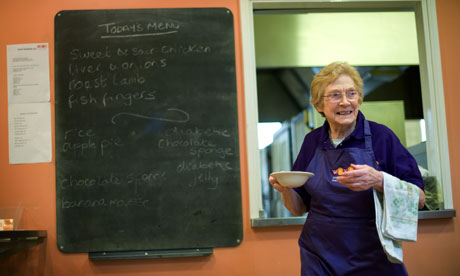
WRVS volunteer Barbara Dishley serves lunch at the Hanley Centre, Stoke-on-Trent
Debate about our ageing society is conducted typically in terms of the problems and costs of supporting growing numbers of older people. But a study published today turns that premise on its head. Far from being a burden on the economy, it says, older people are in fact net contributors.

The research, for volunteer charity WRVS, is the first to attempt to quantify the role of older generations. Taking together the tax payments, spending power, caring responsibilities and volunteering effort of people aged 65-plus, it calculates that they contribute almost £40bn more to the UK economy than they receive in state pensions, welfare and health services.

Moreover, the research suggests, this benefit to the economy will increase in coming years as the "baby boomer" cohort enters retirement. By 2030, it is projected, the net contribution of older people will be worth some £75bn.

Lynne Berry, WRVS chief executive, admits that the calculations are a first, necessarily rough, stab at assessing the value of the part played by older people in society. But she hopes that the figures will have the kind of positive impact on the public debate about the ageing society that quantifying the contribution of informal carers – currently put at £87bn gross – has had on the profile of the carers' movement since the first estimate was made in 1993.

"It was once you could put a figure on the contribution that carers made to support relatives that the whole issue of caring got that national prominence," says Berry. "We want to see the contribution made by older people really change the story from them being a drain on society to them being the most extraordinary resource."

The WRVS co-ordinates the efforts of some 50,000 volunteers who deliver meals-on-wheels, staff community clubs, run shops and cafes in hospitals and do much else besides. Many of the volunteers have retired from paid employment and it is the potential of the "younger older" to play a growing role in this way that Berry sees as a solution to the challenge posed by the pincer effect of the ageing society and the retrenchment of public services.

An ICM poll carried out for today's study found that 65% of older people say they regularly help out elderly neighbours, are the most likely of all adult age groups to do so, and that 55% of those who say they volunteer either formally or informally are members of between one and five community groups – again, more than any other age cohort.

Berry says: "The baby boomer generation is the best educated, healthiest and fittest group of younger older people this country has ever seen. All these people are now coming up to 65 and the question is, how are we going to make sure that they use their skills in their communities? It has got to be one of the 'big society' asks to grab this generation and exploit their talents as a form of social glue."

The study's calculations on the net contribution of older people have been made by economic analysts SQW. It estimates that older people benefit the economy to a total of £175.9bn, including delivering social care worth £34bn and volunteering worth at least £10bn, compared to welfare costs of £136.3bn.

By 2030, the study suggests, the estimated benefit will be £291.1bn, including almost £52bn worth of social care and £15bn through volunteering, compared to projected welfare costs of £216.2bn.

The figures and methodology have been vetted by independent experts including Robert McNabb, professor of economics at Cardiff Business School. He says that while he has some reservations about parts of the analysis, particularly the forward projection, he is sure that older people do make a net positive contribution and, indeed, suspects that the value of their caring and volunteering may have been under-rated in the study.

"People tend to be modest when they are asked how many hours they spend helping neighbours, or how long they spend volunteering at the local hospital," says McNabb. "So although the survey shows what a significant amount of time – and therefore money – is involved in these activities, I think some of these figures are really quite conservative."

Read: See seniors as part of the solution

Friday, 6 June 2014

See seniors as part of the solution 
By Rosemary Khoo AND Chiang Hai Ding Published: May 29, 4:01 AM Updated: May 29, 4:10 AM


Many seniors in Singapore, more so in the heartlands of the Housing and Development Board (HDB) than in the bungalow belt, worry about their future. Where will they live in their old age? Can they pay their medical bills? Will their Central Provident Fund (CPF) savings last their lives? Will they die alone and uncared for?

Their worries are quite remarkable because Singaporeans have among the highest per capita incomes and, through the CPF, are among the world’s biggest savers. Singapore has one of the most successful public housing programmes and one of the most effective and cost-efficient health systems. It is also quite remarkable because senior issues have, in fact, received a lot of attention from our Government and there is a lot going for seniors here.


More than 30 years ago, the first study of our ageing population was made — the Howe Yoon Chong Report in 1984, which was followed by two Inter-Ministerial Committee reports, Healthcare of the Elderly and The Ageing Population, in 1997-1998. 

In 2003, the Committee on Ageing Issues was established and in 2006, a minister in charge of ageing issues was appointed. 

So, what are the reasons for the worries of senior citizens? 

There are two. 

NOT SEEING FULL PICTURE

On the part of some movers and shakers, there is, first, an ageist way of thinking. Singaporeans’ life expectancy of 82 years is the fourth best in the world. Yet, instead of celebrating one of the successes of the Singapore Story, they bemoan the impending “silver tsunami”; seniors are regarded as a “burden”.

They point to an antiquated statistic, the “dependency ratio” of the number of working adults who supposedly support one economically useless senior. This overlooks the fact that many seniors are, in fact, asset-rich, having paid for the HDB flats that they live in.

Second, there is the unfortunate tendency towards silo thinking on ageing issues — to look at seniors as a bundle of problems that have to be tackled one at a time. While many “solutions” have been attempted, they address specific problems and fall short of looking after the whole person, the senior.

Recently, about 60 National University of Singapore (NUS) senior alumni and friends — mostly over 65 years old – met at a forum, supported by the Our Singapore Committee, to examine and help propose solutions to issues of our ageing population. 

While looking to the Government to adopt a “whole-of-government” approach and to take the lead in some areas, the senior alumni also proposed how they, and other seniors, could themselves contribute to the solution. 

VERTICAL KAMPUNGS FOR SENIORS
One starting point is the success story that is the HDB, which houses more than 80 per cent of our citizens. However, Singapore seniors have four basic needs: Housing, healthcare, money and friends. As such, retired architect Andrew Tan proposes that the HDB build “vertical kampungs” — new senior housing units based on a modular design and are located in existing HDB estates. 

Seniors could be allowed to trade-in their HDB flats for these new type of units, which could come with a basic healthcare package in the form of health promotion programmes and periodic health screening, as well as a national insurance plan which pays for medical care. 

Assuming that an old three-room flat is valued at S$400,000, and a new HDB unit at S$36,000, the participating seniors would be able to afford their healthcare and medical needs and still have spending money left over. This holistic approach would require the HDB to work with the Ministries of Finance, Health and Family and Social Development. 

Living within such an HDB community, seniors can then be enabled to seek fulfilment in meaningful social activities. These could include volunteering and lifelong learning. 

It is a myth, stressed NUS Professor of Psychological Medicine Kua Ee Heok, that people over 65 are frail and of no economic value. Research shows that many seniors are involved in community activities as volunteers in schools, libraries, museums, children’s centres, seniors’ homes and so on. Indeed, most of the participants at the session were volunteers, and they believe more could be done to create awareness of the needs of society and to equip volunteers with proper skills. 

HEALTHY IN MIND AND BODY
What also helps seniors to enrich and prolong their lives is lifelong learning. One suggestion from a group led by NUS Senior Alumni Vice-President, Mr Chua Joon Eng, was: Why not create a fund for seniors to facilitate this — CogniSave, similar in concept to MediSave, since mental health is as important as physical well-being?

Most courses offered in educational institutions here are work-related. For seniors who are more able to enjoy their leisure, there is a mishmash of courses, forums and talks offered by disparate bodies of presenters. 

One promising development last year was the start of the Singapore arm of the University of the Third Age — where there are no assignments, tests or term papers. 

It provides a space for seniors to interact and where “those who teach shall also learn, and those who learn shall also teach”.

To have peace of mind, dignity and hope in their old age, seniors should be empowered to arrange for their own healthcare costs. One participant, for example, proposed Forward Planning Health Insurance on a national basis, in which higher premiums are paid earlier during one’s working life and premiums get lower as one ages.

Ultimately, as geriatrician Carol Tan reminds us all, good health is essential to ageing with dignity and hope. “Seniors will be less fearful when they are aware that there are services available, affordable and accessible,” she added. 

Can we transform the latter years of senior citizens in Singapore into golden years? We believe we can. 

Credits: http://www.todayonline.com/commentary/see-seniors-part-solution?singlepage=true 

TEDTalks: What it’s like to grow old, in different parts of the world

An interesting article that explores different attitudes and practices to the elderly in different parts of the world.

"There's an irony behind the latest efforts to extend human life: It's no picnic to be an old person in a youth-oriented society. Older people can become isolated, lacking meaningful work and low on funds. In this intriguing talk, Jared Diamond looks at how many different societies treat their elders — some better, some worse — and suggests we all take advantage of experience."


What it’s like to grow old, in different parts of the world
Posted by: Elizabeth Jacobs November 25, 2013 at 3:55 pm EDT

The world’s population is getting older. Across the globe, people are living longer thanks to improvements in healthcare, nutrition and technology. This population shift brings with it incredible possibilities, but also a new set of challenges. How do we care for our elderly?


In today’s talk, Jared Diamond examines the vast differences in how societies across the globe view and treat their senior citizens. Some groups revere and respect their oldest members, while others see them as senile and incompetent, making them the butt of jokes. In some societies, children care for their parents at home, while in other cultures, children put their parents in homes where others care for them. Some cultures even see their elderly as a burden and resource drain, and opt for more violent approaches to senior care.

The Western system for elder care is far from perfect, notes Diamond, and everyone stands to learn something from how different societies care for their seniors. Watch his talk to hear what he means, and below, read some further insights on how people across the globe treat their old folks.

Who is considered old?
As Diamond mentions in his talk, the perceived value of the elderly is an important factor in determining whether seniors are respected or not. And this may be a function of who is considered old. In the United States a senior citizen is defined as someone who is 65+. But in other parts of the world, like New Guinea, anyone 50 or over is considered lapun, or an old man. As Diamond points out in his book, The World Until Yesterday, this difference has wide implications, as the two age groups tend to have a different set of physical and mental abilities.

The United Nations recently turned its attention to developing policy to support aging populations around the world — and their line for elderly begins at 60. In fact, the UN has started celebrating the International Day of Older Persons in October, which acknowledges the contributions to society made by those over the 60-line.

Where do the elderly live?
The Confucian teaching of filial piety shapes the living arrangements of elderly Chinese, Japanese and Korean people. About ¾ of elderly Japanese parents live with their adult children, a pattern replicated in Korea and China. China’s new Elderly Rights Law mandates that children visit their parents frequently, no matter how far away they live. If children don’t comply, they could face fines or jail time. “We raise our children to take care of us when we get old,” one Chinese senior citizen told the BBC.

But of course, it doesn’t take Confucian ideals to place value on spending time with the elderly. Article 207 of the French Civil Code, which was passed in 2004, requires that adult children “keep in touch” with their elderly parents. The law was passed, according to a recent article in The Week, in response to a study that showed a high rate of elderly suicides in France, and to a heat wave in which 15,000 mostly elderly people died,

In India and Nepal, the tradition has long been: a newlywed couple moves in with the groom’s family, in what’s called a patrilocal living arrangement. But shifting economic forces are reshaping residence patterns, according to the University of Maryland’s India Human Development Survey. As parts of the country urbanize, children are moving hundreds of miles away from their parents. The Indian and Nepalese governments are addressing this by developing state-run elderly care programs.

What words describe the elderly?
A culture’s respect for the elderly is often reflected in its language. Honorific suffixes like –ji in Hindi enable speakers to add an extra level of respect to important people — like Mahatma Gandhi, who is often referred to as Gandhiji. According to Wikipedia, mzee in Kiswahili — spoken in many parts of Africa — is a term used by younger speakers to communicate a high level of respect for elders. And as this report reveals, the Hawaiian word kÅ«puna means elders, with the added connotation of knowledge, experience and expertise.

And then there’s the suffix –san in Japanese, which is often used with elders, reveals the nation’s deep veneration for the old. The country regularly holds Respect for the Aged Day, with the media running special features that profile the oldest Japanese citizens. The Japanese also see a person’s 60th birthday as a huge event. Kankrei, as the celebration is called, marks a rite of passage into old age.

What special foods can the elderly eat?
Around the world, a number of traditional societies reserve certain foods for the elderly, Diamond reveals in his book. In Nebraska, only senior members of the Omaha Indians eat bone marrow — they believe that if young men do so, they will sprain an ankle. Similarly, the Iban of Borneo advise that only old men eat venison because, if the young taste it, it could make them timid. In Siberia, the Chukchi believe that reindeer milk will make young men impotent and young women flat-chested, so it’s reserved only for older people.

The group with the strongest food taboos: the Arunta Aboriginies, who live near Ayers Rock in Australia. Eating certain foods can lead to a “series of dire consequences for young people,” as Diamond notes in The World Until Yesterday. The Arunta believe that eating parrots will create a hollow in a young man’s head, and a hole will grow in the chin. If young Arunta men eat wildcat, they will develop painful and smelly sores on their head and neck. According to societal belief, young women who eat kangaroo tails will age prematurely … and go bald. Meanwhile, quail consumption will lead to stunted breast development, and conversely, eating brown hawks will lead the breasts to swell and burst, without even producing milk.

Do the elderly have special powers?
As Diamond mentions in his talk, many elders are respected because of highly specialized skills and knowledge. For example, Hawaiian grandmothers are revered for their unique knowledge and skill at creating ornate leis and feather accessories. Similarly, since an elderly woman in New Guinea was the only person alive who witnessed a devastating typhoon, her people looked to her for guidance on which plants are safe to eat if another disaster were to strike. Even Western societies revere the experience associated with age — the average age for a US President is 54; the average age for a Supreme Court justice is 53.

But certain societies take this a step further and attribute magical powers to the elderly. The Huaorani people of Ecuador believe that elderly shamans, called mengatoi, are endowed with magical powers, according to this Thinkquest article. This society believes that shamans can transform into jaguars. These elderly healers sit with the infirm to channel their animal spirits a cure for disease.

And what does the end of life look like?
End-of-life decisions vary drastically across cultures. Some societies do everything possible to keep their elderly alive. Other groups, however, see old and frail members as a burden, and thus take steps to end their lives. In his talk, Diamond notes that eldercide typically happens in communities that are either nomadic, or that live in harsh climates with limited resources.

According to a study in American Ethnologist, the Chukchi of Siberia practice voluntary death, in which an old person requests to die at the hand of a close relative when they are no longer in good health. And in The World Since Yesterday, Diamond notes that the Crow Indians in the US and Norse tribes in Scandinavia follow similar practices — the elderly put themselves in an impossible situation, like setting out to sea on a solo voyage. Finally, the Ache of Paraguay let their men wander off to die on the “white man’s road,” and — perhaps shockingly to some — they kill elderly women by breaking their necks.

On the flip side, the curious Greek island of Ikaria seems to have life-extending magic in its soil, notes The New York Times. Residents of this small Mediterranean island are four times more likely than their American counterparts to live to 90, and they live on average 8 to 10 years longer after being diagnosed with cancer or cardiovascular disease. Its residents don’t rush through life: they stay up late, eating Kalamata olives, drinking mountain tea and swimming in the crystal-clear water. The answer to this island’s longevity probably lies in its eating patterns and relaxed lifestyle, but nobody can definitively explain the magic behind this island of centenarians.

What are the traditions surrounding old age in your culture?
 

Tags

english (23) writing (23) tuition (20) expository (19) secondary school (19) lessons (16) general paper (11) o levels (11) jc (8) model essay (8) aging population (5) interesting (5) primary school (5) creative writing (3) story (3) environment (2) idioms (2) practice (2) climate change (1) cloze (1) grammar (1) inequality (1) materialism (1) social (1) sports (1) synthesis (1) technology (1)

Archives