Showing posts with label writing. Show all posts

30 Incorrectly Used Words That Can Make You Look Horrible

Thursday, 31 July 2014

Here's a tongue-in-cheek take on the most commonly misused words in English. I've had to answer these questions countless times, or worse, having to correct these mistakes in the students' work. The first step is to be aware, so please check if you're making any!

30 Incorrectly Used Words That Can Make You Look Horrible

Easy to get wrong. And easy to get right

Adverse and averse

Adverse means harmful or unfavorable; “Adverse market conditions caused the IPO to be poorly subscribed.” Averse means dislike or opposition; “I was averse to paying $18 a share for a company that generates no revenue.”
But you can feel free to have an aversion to adverse conditions.

-

Affect and effect

Verbs first. Affect means to influence; “Impatient investors affected our roll-out date.” Effect means to accomplish something; “The board effected a sweeping policy change.” How you use effect or affect can be tricky. For example, a board can affect changes by influencing them, or can effect changes by implementing them. Use effect if you’re making it happen, and affect if you’re having an impact on something someone else is trying to make happen.
As for nouns, effect is almost always correct; “Once he was fired he was given 20 minutes to gather his personal effects.” Affect refers to emotional states so unless you’re a psychologist, you’re probably not using it.

-

Compliment and complement

Compliment is to say something nice. Complement is to add to, enhance, improve, complete or bring close to perfection. So, I can compliment your staff and their service, but if you have no current openings, you have a full complement of staff. And your new app may complement your website.
For which I may decide to compliment you.

-

Criteria and criterion

“We made the decision based on one overriding criteria,” sounds pretty impressive but is wrong.
Remember: one criterion, two or more criteria. Although you could always use reason or factors and not worry about getting it wrong.

-

Discreet and discrete

Discreet means careful, cautious, showing good judgment; “We made discreet inquiries to determine whether the founder was interested in selling her company.”
Discrete means individual, separate or distinct; “We analyzed data from a number of discrete market segments to determine overall pricing levels.” And if you get confused, remember you don’t use “discreetion” to work through sensitive issues; you exercise discretion.

-

Elicit and illicit

Elicit means to draw out or coax. Think of elicit as the mildest form of extract or, even worse, extort. So if one lucky survey respondent will win a trip to the Bahamas, the prize is designed to elicit responses.
Illicit means illegal or unlawful. I suppose you could “illicit” a response at gunpoint … but best not.

-

Farther and further

Farther involves a physical distance; “Florida is farther from New York than Tennessee.” Further involves a figurative distance; “We can take our business plan no further.” So, as we say in the South, “I don’t trust you any farther than I can throw you.” Or, “I ain’t gonna trust you no further.”
(Seriously. I’ve uttered both of those sentences. More than once.)

-

Imply and infer

The speaker or writer implies. The listener or reader infers. Imply means to suggest, while infer means to deduce (whether correctly or not). So, I might imply you’re going to receive a raise. You might infer that a pay increase is imminent. (But not eminent, unless the raise will be prominent and distinguished.)

-

Insure and ensure

This one’s easy. Insure refers to insurance. Ensure means to make sure. So if you promise an order will ship on time, ensure it actually happens. Unless, of course, you plan to arrange for compensation if the package is damaged or lost — then feel free to insure away.

-

Number and amount

I goof these up all the time. Use number when you can count what you refer to; “The number of subscribers who opted out increased last month.” Amount refers to a quantity of something you can’t count; “The amount of alcohol consumed at our last company picnic was staggering.”
Of course, it can still be confusing: “I can’t believe the number of beers I drank,” is correct, but so is, “I can’t believe the amount of beer I drank.” The difference is I can count beers, but beer, especially if I was way too drunk to keep track, is an uncountable total — so amount is the correct usage.

-

Precede and proceed

Precede means to come before. Proceed means to begin or continue. Where it gets confusing is when an “ing” comes into play. “The proceeding announcement was brought to you by …” sounds fine, but preceding is correct since the announcement came before.
If it helps, think precedence: anything that takes precedence is more important and therefore comes first.

-

Principal and principle

A principle is a fundamental; “We’ve created a culture where we all share certain principles.” Principal means primary or of first importance; “Our startup’s principal is located in NYC.” (Sometimes you’ll also see the plural, principals, used to refer to executives or (relatively) co-equals at the top of a particular food chain.)
Principal can also refer to the most important item in a particular set; “Our principal account makes up 60% of our gross revenues.”
Principal can also refer to money, normally the original sum that was borrowed, but can be extended to refer to the amount you owe — hence principal and interest.
If you’re referring to laws, rules, guidelines, ethics, etc., use principle. If you’re referring to the CEO or the president (or the individual in charge of the high school), use principal.

-

And now for those dreaded apostrophes:

It’s and its

It’s is the contraction of it is. That means it’s doesn’t own anything. If your dog is neutered (that way we make the dog, however much against his will, gender-neutral) you don’t say, “It’s collar is blue.” You say, “Its collar is blue.” Here’s an easy test to apply: Whenever you use an apostrophe, un-contract the word to see how it sounds. In this case, turn it’s into it is. “It’s sunny,” becomes, “It is sunny.” Sounds good to me.

-

They’re and their

Same with these; they’re is the contraction for they are. Again, the apostrophe doesn’t own anything. We’re going to their house, and I sure hope they’re home.

-

Who’s and whose

“Whose password hasn’t been changed in six months?” is correct. “Who is [the un-contracted version of who's] password hasn’t been changed in six months?” sounds silly.

-

You’re and your

One more. You’re is the contraction for you are. Your means you own it; the apostrophe in you’re doesn’t own anything. For a long time a local nonprofit had a huge sign that said “You’re Community Place.”
Hmm. “You Are Community Place”?
Probably not.

Credit

Read: What is So Good About Growing Old

Tuesday, 10 June 2014

What is So Good About Growing Old 
Forget about senior moments. The great news is that researchers are discovering some surprising advantages of aging 

By Helen Fields Smithsonian Magazine | July 2012
Even as certain mental skills decline with age—what was that guy’s name again?—scientists are finding the mind gets sharper at a number of vitally important abilities. In a University of Illinois study, older air traffic controllers excelled at their cognitively taxing jobs, despite some losses in short-term memory and visual spatial processing. How so? They were expert at navigating, juggling multiple aircraft simultaneously and avoiding collisions.
People also learn how to deal with social conflicts more effectively. For a 2010 study, researchers at the University of Michigan presented “Dear Abby” letters to 200 people and asked what advice they would give. Subjects in their 60s were better than younger ones at imagining different points of view, thinking of multiple resolutions and suggesting compromises.
It turns out that managing emotions is a skill in itself, one that takes many of us decades to master. For a study published this year, German researchers had people play a gambling game meant to induce regret. Unlike 20-somethings, those in their 60s didn’t agonize over losing, and they were less likely to try to redeem their loss by later taking big risks.
These social skills may bring huge benefits. In 2010, researchers at Stony Brook University analyzed a telephone survey of hundreds of thousands of Americans and found that people over 50 were happier overall, with anger declining steadily from the 20s through the 70s and stress falling off a cliff in the 50s.
This may be news to people who equate being old with being sad and alone, but it fits with a body of work by Laura Carstensen, a psychologist at Stanford. She led a study that followed people ages 18 to 94 for a decade and found that they got happier and their emotions bounced around less. Such studies reveal that negative emotions such as sadness, anger and fear become less pronounced than in our drama-filled younger years.
Cornell sociologist Karl Pillemer and co-workers interviewed about 1,200 older people for the book 30 Lessons for Living: Tried and True Advice from the Wisest Americans. “Many people said something along these lines: ‘I wish I’d learned to enjoy life on a daily basis and enjoy the moment when I was in my 30s instead of my 60s,’” he says. Elderly interviewees are likely to “describe the last five or ten years as the happiest years of their lives.”
“We have a seriously negative stereotype of the 70s and beyond,” says Pillemer, “and that stereotype is typically incorrect.

Read: Our Demographic Challenges and What These Means to Us

Our Demographic Challenges and What These Means to Us

LOW LOCAL BIRTH RATES AND LONGER LIFE EXPECTANCIES
Babies
As our post-war Baby Boomers turn 65 years old from 2012 onwards, Singapore will experience an unprecedented age shift. Over 900,000 Baby Boomers, more than a quarter of the current citizen population, will retire from the workforce and enter their silver years. At current birth rates and without immigration, the median age of our citizens will rise to 47 in 2030 from 39 in 2011.
As is the case in other developed East Asian urbanised societies like Japan, Taiwan and Hong Kong, our declining birth rates are due to rising singlehood, later marriages, and married couples having fewer children. Broader social and economic factors also affect marriage and parenthood decisions. For example, the expansion of higher education opportunities while welcome, has also delayed entry into the workforce and family formation.
Singapore’s life expectancy has increased by 10 years over the last 3 decades: from 72 years in 1980 to 82 years in 2010. Our life expectancy is one of the highest in the world. With increasing life expectancy and low birth rates, we face the prospect of a shrinking and ageing citizen population and workforce.
PMO_Stock_453

A SHRINKING AND AGEING POPULATION AND WORKFORCE

At current birth rates and without immigration, our citizen population will begin to shrink around 2025.
The number of elderly citizens will triple to 900,000 by 2030, and they will be supported by a smaller base of working-age citizens. There are currently about 6.3 citizens in the working-ages of 20 to 64 years, for each citizen aged 65 and above. By 2030, there will only be 2.1 working-age citizens for each citizen aged 65 and above.
YearElderly CitizenCitizens in working-age band of 20-64 years of age
Declining Old-Age Support Ratio
Source: Department of Statistics
1970113.5
200018.4
201116.3
201514.8
202013.6
202512.6
203012.1
As more citizens retire and with fewer entering the working-age band, the number of working-age citizens will start to shrink by around 2020.
We will feel the impact of this in many ways. We will see a reversal of what is the typical family structure. Today, we generally have a few elderly members of the family with a larger number in the younger generations. By 2030, this family structure is likely to reverse itself with more elderly members than younger ones, as we live longer and each successive generation becomes smaller.
For society as a whole, a declining old-age support ratio points towards an increasing tax and economic burden on our working-age population. A shrinking and ageing population could also mean a less vibrant and innovative economy. There will be a shrinking customer base in Singapore, and companies may not be able to find adequate manpower. Multinational companies may therefore choose not to set up operations in Singapore, and Singapore-based businesses may down-size, close down or relocate. As a result, we could see slower business activity and fewer career options that will match the higher aspirations of Singaporeans. With an increasingly educated and mobile population, more of our young people could choose to leave for other exciting global cities, hollowing out our population and workforce, and worsening our old-age support ratio.

Read: Older people are an asset, not a drain

Older people are an asset, not a drain

Volunteering and caring responsibilities mean older people are net contributors to the economy, a report has revealed
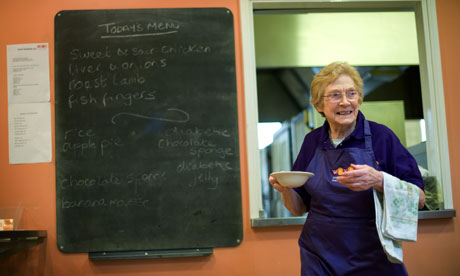
WRVS volunteer Barbara Dishley serves lunch at the Hanley Centre, Stoke-on-Trent
Debate about our ageing society is conducted typically in terms of the problems and costs of supporting growing numbers of older people. But a study published today turns that premise on its head. Far from being a burden on the economy, it says, older people are in fact net contributors.

The research, for volunteer charity WRVS, is the first to attempt to quantify the role of older generations. Taking together the tax payments, spending power, caring responsibilities and volunteering effort of people aged 65-plus, it calculates that they contribute almost £40bn more to the UK economy than they receive in state pensions, welfare and health services.

Moreover, the research suggests, this benefit to the economy will increase in coming years as the "baby boomer" cohort enters retirement. By 2030, it is projected, the net contribution of older people will be worth some £75bn.

Lynne Berry, WRVS chief executive, admits that the calculations are a first, necessarily rough, stab at assessing the value of the part played by older people in society. But she hopes that the figures will have the kind of positive impact on the public debate about the ageing society that quantifying the contribution of informal carers – currently put at £87bn gross – has had on the profile of the carers' movement since the first estimate was made in 1993.

"It was once you could put a figure on the contribution that carers made to support relatives that the whole issue of caring got that national prominence," says Berry. "We want to see the contribution made by older people really change the story from them being a drain on society to them being the most extraordinary resource."

The WRVS co-ordinates the efforts of some 50,000 volunteers who deliver meals-on-wheels, staff community clubs, run shops and cafes in hospitals and do much else besides. Many of the volunteers have retired from paid employment and it is the potential of the "younger older" to play a growing role in this way that Berry sees as a solution to the challenge posed by the pincer effect of the ageing society and the retrenchment of public services.

An ICM poll carried out for today's study found that 65% of older people say they regularly help out elderly neighbours, are the most likely of all adult age groups to do so, and that 55% of those who say they volunteer either formally or informally are members of between one and five community groups – again, more than any other age cohort.

Berry says: "The baby boomer generation is the best educated, healthiest and fittest group of younger older people this country has ever seen. All these people are now coming up to 65 and the question is, how are we going to make sure that they use their skills in their communities? It has got to be one of the 'big society' asks to grab this generation and exploit their talents as a form of social glue."

The study's calculations on the net contribution of older people have been made by economic analysts SQW. It estimates that older people benefit the economy to a total of £175.9bn, including delivering social care worth £34bn and volunteering worth at least £10bn, compared to welfare costs of £136.3bn.

By 2030, the study suggests, the estimated benefit will be £291.1bn, including almost £52bn worth of social care and £15bn through volunteering, compared to projected welfare costs of £216.2bn.

The figures and methodology have been vetted by independent experts including Robert McNabb, professor of economics at Cardiff Business School. He says that while he has some reservations about parts of the analysis, particularly the forward projection, he is sure that older people do make a net positive contribution and, indeed, suspects that the value of their caring and volunteering may have been under-rated in the study.

"People tend to be modest when they are asked how many hours they spend helping neighbours, or how long they spend volunteering at the local hospital," says McNabb. "So although the survey shows what a significant amount of time – and therefore money – is involved in these activities, I think some of these figures are really quite conservative."

Read: Why is Inequality the Hot Issue Right Now?

WHY IS INEQUALITY THE BIG HOT ISSUE RIGHT NOW?


Writer Jimmy Guterman takes society’s temperature and digs into the reasons we’re all talking about inequality.

Thomas Piketty’s Capital in the 21st Century is a book of our moment. It may be the most unlikely egghead highbrow bestseller since A Brief History of Time – and it’s a lot longer than Stephen Hawking’s slender guide. Piketty’s 577-page tome (685 with index) argues that economic inequality is increasing and that’s a bad thing. That argument is resonating at a time when politicians of all stripes in democracies on multiple continents are also arguing that economic inequality is increasing and that’s a bad thing. The politicians are responding to something that their constituents know already.
This fascination with economic inequality is not an immediate reaction to an external event, but it might be a delayed reaction, an instance of cultural post-traumatic stress. By many measures, the world economic crisis began seven long years ago. It may have taken that long for the shock to be understood; the recent arguments that accompanied the release of the memoir by former U.S. Treasury Secretary Timothy Geithner suggest that the wounds are still raw. But, just as the famous saying goes, “You don’t want a good crisis to go to waste,” will we let this increased interest in economic inequality turn into something useful or will it fade away?
Piketty’s book doesn’t define the moment so much as it is a symptom of the moment. U.S. Senator Elizabeth Warren is touting her new book, A Fighting Chance, which is part standard political autobiography and part moral outrage at inequality. (Among American politicians in the recent past, John Edwards may be the one who has spoken most frequently and movingly on the topic of inequality, but he is too damaged a public figure to carry that banner any more.) Two recent short-lived U.S. political movements, Occupy on the left and the Tea Party on the right, were built on the idea that there is something fundamentally unfair going on. They offered drastically different diagnoses, but they both saw the U.S. as irrevocably moving away from fairness.
THERE’S EVEN MORE DISPARITY BETWEEN THE RICH AND THE POOR NOW IN SOUTH AFRICA THAN THERE WAS DURING APARTHEID.
And it’s not just in America that the rift is growing between the top 1% or so and everyone else. It’s a global issue. In Russia, 110 billionaires control 35 percent of the sprawling nation’s wealth (and 93 percent of the country have assets of less than $10,000). The global “race to the bottom” for labor costs leads to tragedies like last year’s Rana Plaza building collapse in Bangladesh, the deadliest garment-factory accident in history, the sort of event that can occur only if an economy’s modus operandi is to exploit the many for the needs of the few. Even countries once lauded for their relative economic equality, like Sweden, are seeing the richest of the rich grab a larger percentage of the nation’s wealth. The Gini coefficient, a measure of income inequality, shows there’s even more disparity between the rich and the poor now in South Africa than there was during apartheid. Perhaps the most vivid evidence of the global nature of global inequality is the new home, in Mumbai, of mogul Mukesh Ambani: a 27-story, 400,000-square-foot skyscraper, complete with a “health floor” and a full-size ballroom.
Of course, life has always been unfair. Utopian movements that promise to address this tend to either evaporate or morph into dystopias, as happened in the USSR. (To be fair, some argue that Piketty’s call for a global tax on wealth is Utopian, too.) Inequality has been a topic of best-selling books in the West at least as far back as the New Testament (the book of James in particular). The recent volumes by Piketty and his many comrades show that the inequality problem may have gotten worse in recent decades, but it has been bad, even worse than now, many times before. Inequality isn’t new. What is new is the attention it’s getting — and how quickly that recognition has moved rhetoric to policy. A national referendum in Switzerland has given shareholders more power in limiting executive pay. From a country whose wealth is based in large part on hosting the most opaque banks offered up by any democratic country, that’s an encouraging start.
CONSIDER THE CURRENT LIGHT BEING THROWN ON INCOME INEQUALITY AS THE ECONOMIC VERSION OF FASHION.
The desire, if not yet the will, to reduce income inequality might also be a fad, but that doesn’t mean it’s a bad thing. Sometimes a fad can be a harbinger of change. Fads provide simple solutions that don’t necessarily address the nuances of complex problems (you’ll lose weight if you make only one change to your diet or behavior, your company will get bought out by Google if you follow these 10 laws of success), but they also shine a light on those problems.
So you can consider the current light being thrown on income inequality as the economic version of fashion, a change in hemline length that might make for a better world. It may seem ridiculous to compare something as elevated as economic research with pop culture, but they’re on the same continuum. It’s easy to make fun of well-meaning celebrities like Bono or Angelina Jolie who make inequality their public issue. It’s fair game to acknowledge that there’s some narcissism embedded in celebrity do-gooding. But the fact is that many, many more people know something about global issues of wealth and poverty because of celebrities. I don’t want to count on a rock star or a movie actor to lead a revolution, but I don’t want to bar them from the party either. Just because something starts as a fad doesn’t mean it has to remain a fad. Whenever a one-percenter acknowledges the problem and suggests a solution, be that one-percenter an entertainer, an astonishingly successful investor from Omaha, or a software entrepreneur who’s become the most important philanthropist of our time, a space for hope opens up.
Inequality is never going to go away. Redirecting a handful of super-rich toward the needs of the masses is only a small step in the right direction. But it is the right direction. Anything that can help turn around the massive, slow ocean liner we all live on, an ocean liner inching inexorably toward a waterfall, be it as weighty as Capital or as slight as a commodity item that gains some faddish meaning because it happens to be colored red, should be welcomed.
Jimmy Guterman is editorial director of Collective Next and a curator of TEDxBoston. He spoke at TED University in 2008 and at TED2012.

Read: Norway uses waste as eco-friendly fuel

Monday, 9 June 2014

Norway burns rubbish to get energy - and avoids resorting to landfill
Forget coal, oil, shale gas, even nuclear. The bin bag - full of your household waste - is becoming one of Norway's fuels of choice.
Try to imagine the smell when a bin lorry passes you on the street on a hot summer's day. Breathe it in through your nostrils. Stinks, doesn't it? Now multiply it by a thousand.
That's what it is like inside the largest energy recovery facility in Norway, the Klemetsrud plant. A vast concrete hall of waste. Tens of thousands of tonnes of rubbish piled up. The conveyor belts clunk and clank as more pours in. Bin lorries reverse towards the chutes and tip out more plastic bags of waste.
A huge industrial claw swoops down, its pincers reaching round a tonne of rubbish, picking it up and transporting it to the other end of the hall, where it is dropped. A cloud of white dust builds, and soon fills the hall. It is not good to stay in here too long.
This is where the waste thrown out by millions of households from Norway, Britain and elsewhere is turned into heat and electricity for the city of Oslo.
Cheap heating
The rubbish is pre-sorted. Everything that can be recycled is meant to have been taken out, but even then they are still left with more than 300,000 tonnes a year.
They do not see it as waste here - they see it as energy.
"Four tonnes of waste has the same energy content as one tonne of fuel oil," says the director of the waste-to-energy agency in Oslo, Pal Mikkelsen.
"That means a lot of energy, and we use very little energy to transport it."
One tonne of fuel oil, Mr Mikkelsen says, could heat a house for half a year. In other words, take just part of an English bin lorry's maximum load picked up on the streets of Leeds or Bristol, turn it into energy here - and you can heat a home in Oslo for half a year.
The process is simple. The waste, tonne by tonne of it, is dropped into an incinerator. It soars to 850 degrees. Peeking through a small porthole of toughened glass, the fire burns bright orange with a fierce roar of flames.
Greener schools
Not everything is burned. Old tin cans and some mattress springs are left. At the end of the process they are left with ash, metal -which is recycled - and a lot of heat.
The heat boils water. The steam drives a turbine, which produces electricity. And the scalding water is piped off from the plant, to houses and public schools across Oslo.
Which means at Bjoernholt School the technical manager, Agnar Andersen, does not have to worry about fuel deliveries during the harsh Norwegian winter any more.
"We don't have to think about fuel oils or fossil fuels. They are phasing out the last school this year with fossil fuels."
At full capacity the plant will provide all the heat and electricity for Oslo's schools and heat for 56,000 homes.
An environmentalist's dream, you might have thought. Not necessarily, cautions the chair of Friends of the Earth Norway, Lars Haltbrekken.
"The overall goal from an environmental perspective should be to reduce the amount of waste, reuse what we can reuse, recycle, and then the fourth option is to burn it and use the energy.
"We have created such an overcapacity in these power plants in Norway and Sweden. We have made ourselves dependent on producing more and more garbage."
Send us your rubbish
Supporters disagree, and point out that, used together, all of Europe's current waste-to-energy plants could only consume about 5% of the continent's total annual landfill. Norway - they say - is actually helping to dispose of some of that waste in the best way possible.
That is certainly true in the case of the English cities Leeds and Bristol. Both export waste to Oslo. Rather than pay for it to go into landfill after the recyclable bits have been removed, they actually pay Oslo to take it off their hands.
So, Oslo is paid to dispose of the rubbish, and gets energy out of it as well.
The waste-to-energy revolution can also be heard on the streets of the Norwegian capital, as the number 144 bus rumbles past.
It is powered by biogas, created from the city's decaying organic matter. One kilogramme of food waste produces half a litre of fuel. Use all of the organic waste they have and they will be able to power 135 buses year-round in Oslo.
If this whole project were repeated across Europe, Pal Mikkelsen believes it would make a huge difference.
"I think it would mean we get a lot better level of self-sustainability when it comes to energy. If it's done properly it would also mean a lot more materials recovery. And a sharp decrease in the landfill."
With tight controls to clean up the gases from the burning, Oslo believes converting waste into energy will help it to halve its carbon dioxide (CO2) emissions within 20 years - making a city, whose wealth was built on oil, one of the greenest on the planet.

Phrasal Verbs

Friday, 6 June 2014

Here's an extensive list of Phrasal Verbs on EasyPaceLearning. Please visit the site to revise.

A phrasal verb is verb with a preposition or an adverb which creates a different meaning from the original standalone verb. There are various rules and uses to them. 

- Intransitive phrasal verbs CANNOT be followed by an OBJECT. E.g. He showed up.
- Transitive phrasal verbs CAN be followed by an OBJECT. E.g. I abide by the rules.
- Some phrasal verbs can be separated (I talked her into letting me go), whereas some cannot. (The figures have been accounted for)


Phrasal Verb
Meaning
Example
Abide by
Accept or follow a decision or rule.
We have to ABIDE BY what the court says.
Account for
To explain.
They had to ACCOUNT FOR all the money that had gone missing.
Ache for
Want something or someone a lot.
My partner's been away for a fortnight- I am ACHING FOR her.
Act on
To take action because of something like information received.
The police were ACTING ON a tip from an informer and caught the gang red-handed.
Act on
Affect.
The medicine only ACTS ON infected tissue.
Act out
Perform something with actions and gestures..
They ACTED OUT the story on stage.
Act out
Express an emotion in your behaviour.
Their anger is ACTED OUT in their antisocial behaviour.
Act up
Behave badly or strangely.
My computer's ACTING UP; I think I might have a virus.
Act upon
To take action because of something like information received.
The police were ACTING UPON a tip-off.
Act upon
Affect.
The enzyme ACTS UPON certain proteins.
Add on
Include in a calculation.
You have to ADD the VAT ON to the price they give.
Add up
To make a mathematical total.
We ADDED UP the bill to check it was correct.
Add up
Be a satisfactory explanantion for something.
She explained why the work wasn't ready, but her story doesn't ADD UP.
Add up to
Have a certain result.
Trains delays are getting worse and with the high fares, it all ADDS UP TO misery for the commuters.
Add up to
Come to a certain amount or figure.
The total costs ADD UP TO several million euros.
Agree with
Affect- usually used in the negative to show that something has had a negative effect, especially is it makes you feel bad.
I feel terrible- that food didn't AGREE WITH my stomach.
Aim at
To target.
The magazine is AIMED AT teenagers.
Aim at
Intend to achieve.
They're AIMING AT reducing costs by ten percent.
Allow for
Include something in a plan or calculation.
You should ALLOW FOR delays when planning a journey.

+++ There are a lot more that I can't put on this blog. Visit the site or download the PDF version for your revision. You can easily download it into your phone or save it for offline viewing to revise on the go. There will be upcoming practices and tests on this.

Read: See seniors as part of the solution

See seniors as part of the solution 
By Rosemary Khoo AND Chiang Hai Ding Published: May 29, 4:01 AM Updated: May 29, 4:10 AM


Many seniors in Singapore, more so in the heartlands of the Housing and Development Board (HDB) than in the bungalow belt, worry about their future. Where will they live in their old age? Can they pay their medical bills? Will their Central Provident Fund (CPF) savings last their lives? Will they die alone and uncared for?

Their worries are quite remarkable because Singaporeans have among the highest per capita incomes and, through the CPF, are among the world’s biggest savers. Singapore has one of the most successful public housing programmes and one of the most effective and cost-efficient health systems. It is also quite remarkable because senior issues have, in fact, received a lot of attention from our Government and there is a lot going for seniors here.


More than 30 years ago, the first study of our ageing population was made — the Howe Yoon Chong Report in 1984, which was followed by two Inter-Ministerial Committee reports, Healthcare of the Elderly and The Ageing Population, in 1997-1998. 

In 2003, the Committee on Ageing Issues was established and in 2006, a minister in charge of ageing issues was appointed. 

So, what are the reasons for the worries of senior citizens? 

There are two. 

NOT SEEING FULL PICTURE

On the part of some movers and shakers, there is, first, an ageist way of thinking. Singaporeans’ life expectancy of 82 years is the fourth best in the world. Yet, instead of celebrating one of the successes of the Singapore Story, they bemoan the impending “silver tsunami”; seniors are regarded as a “burden”.

They point to an antiquated statistic, the “dependency ratio” of the number of working adults who supposedly support one economically useless senior. This overlooks the fact that many seniors are, in fact, asset-rich, having paid for the HDB flats that they live in.

Second, there is the unfortunate tendency towards silo thinking on ageing issues — to look at seniors as a bundle of problems that have to be tackled one at a time. While many “solutions” have been attempted, they address specific problems and fall short of looking after the whole person, the senior.

Recently, about 60 National University of Singapore (NUS) senior alumni and friends — mostly over 65 years old – met at a forum, supported by the Our Singapore Committee, to examine and help propose solutions to issues of our ageing population. 

While looking to the Government to adopt a “whole-of-government” approach and to take the lead in some areas, the senior alumni also proposed how they, and other seniors, could themselves contribute to the solution. 

VERTICAL KAMPUNGS FOR SENIORS
One starting point is the success story that is the HDB, which houses more than 80 per cent of our citizens. However, Singapore seniors have four basic needs: Housing, healthcare, money and friends. As such, retired architect Andrew Tan proposes that the HDB build “vertical kampungs” — new senior housing units based on a modular design and are located in existing HDB estates. 

Seniors could be allowed to trade-in their HDB flats for these new type of units, which could come with a basic healthcare package in the form of health promotion programmes and periodic health screening, as well as a national insurance plan which pays for medical care. 

Assuming that an old three-room flat is valued at S$400,000, and a new HDB unit at S$36,000, the participating seniors would be able to afford their healthcare and medical needs and still have spending money left over. This holistic approach would require the HDB to work with the Ministries of Finance, Health and Family and Social Development. 

Living within such an HDB community, seniors can then be enabled to seek fulfilment in meaningful social activities. These could include volunteering and lifelong learning. 

It is a myth, stressed NUS Professor of Psychological Medicine Kua Ee Heok, that people over 65 are frail and of no economic value. Research shows that many seniors are involved in community activities as volunteers in schools, libraries, museums, children’s centres, seniors’ homes and so on. Indeed, most of the participants at the session were volunteers, and they believe more could be done to create awareness of the needs of society and to equip volunteers with proper skills. 

HEALTHY IN MIND AND BODY
What also helps seniors to enrich and prolong their lives is lifelong learning. One suggestion from a group led by NUS Senior Alumni Vice-President, Mr Chua Joon Eng, was: Why not create a fund for seniors to facilitate this — CogniSave, similar in concept to MediSave, since mental health is as important as physical well-being?

Most courses offered in educational institutions here are work-related. For seniors who are more able to enjoy their leisure, there is a mishmash of courses, forums and talks offered by disparate bodies of presenters. 

One promising development last year was the start of the Singapore arm of the University of the Third Age — where there are no assignments, tests or term papers. 

It provides a space for seniors to interact and where “those who teach shall also learn, and those who learn shall also teach”.

To have peace of mind, dignity and hope in their old age, seniors should be empowered to arrange for their own healthcare costs. One participant, for example, proposed Forward Planning Health Insurance on a national basis, in which higher premiums are paid earlier during one’s working life and premiums get lower as one ages.

Ultimately, as geriatrician Carol Tan reminds us all, good health is essential to ageing with dignity and hope. “Seniors will be less fearful when they are aware that there are services available, affordable and accessible,” she added. 

Can we transform the latter years of senior citizens in Singapore into golden years? We believe we can. 

Credits: http://www.todayonline.com/commentary/see-seniors-part-solution?singlepage=true 

TEDTalks: What it’s like to grow old, in different parts of the world

An interesting article that explores different attitudes and practices to the elderly in different parts of the world.

"There's an irony behind the latest efforts to extend human life: It's no picnic to be an old person in a youth-oriented society. Older people can become isolated, lacking meaningful work and low on funds. In this intriguing talk, Jared Diamond looks at how many different societies treat their elders — some better, some worse — and suggests we all take advantage of experience."


What it’s like to grow old, in different parts of the world
Posted by: Elizabeth Jacobs November 25, 2013 at 3:55 pm EDT

The world’s population is getting older. Across the globe, people are living longer thanks to improvements in healthcare, nutrition and technology. This population shift brings with it incredible possibilities, but also a new set of challenges. How do we care for our elderly?


In today’s talk, Jared Diamond examines the vast differences in how societies across the globe view and treat their senior citizens. Some groups revere and respect their oldest members, while others see them as senile and incompetent, making them the butt of jokes. In some societies, children care for their parents at home, while in other cultures, children put their parents in homes where others care for them. Some cultures even see their elderly as a burden and resource drain, and opt for more violent approaches to senior care.

The Western system for elder care is far from perfect, notes Diamond, and everyone stands to learn something from how different societies care for their seniors. Watch his talk to hear what he means, and below, read some further insights on how people across the globe treat their old folks.

Who is considered old?
As Diamond mentions in his talk, the perceived value of the elderly is an important factor in determining whether seniors are respected or not. And this may be a function of who is considered old. In the United States a senior citizen is defined as someone who is 65+. But in other parts of the world, like New Guinea, anyone 50 or over is considered lapun, or an old man. As Diamond points out in his book, The World Until Yesterday, this difference has wide implications, as the two age groups tend to have a different set of physical and mental abilities.

The United Nations recently turned its attention to developing policy to support aging populations around the world — and their line for elderly begins at 60. In fact, the UN has started celebrating the International Day of Older Persons in October, which acknowledges the contributions to society made by those over the 60-line.

Where do the elderly live?
The Confucian teaching of filial piety shapes the living arrangements of elderly Chinese, Japanese and Korean people. About ¾ of elderly Japanese parents live with their adult children, a pattern replicated in Korea and China. China’s new Elderly Rights Law mandates that children visit their parents frequently, no matter how far away they live. If children don’t comply, they could face fines or jail time. “We raise our children to take care of us when we get old,” one Chinese senior citizen told the BBC.

But of course, it doesn’t take Confucian ideals to place value on spending time with the elderly. Article 207 of the French Civil Code, which was passed in 2004, requires that adult children “keep in touch” with their elderly parents. The law was passed, according to a recent article in The Week, in response to a study that showed a high rate of elderly suicides in France, and to a heat wave in which 15,000 mostly elderly people died,

In India and Nepal, the tradition has long been: a newlywed couple moves in with the groom’s family, in what’s called a patrilocal living arrangement. But shifting economic forces are reshaping residence patterns, according to the University of Maryland’s India Human Development Survey. As parts of the country urbanize, children are moving hundreds of miles away from their parents. The Indian and Nepalese governments are addressing this by developing state-run elderly care programs.

What words describe the elderly?
A culture’s respect for the elderly is often reflected in its language. Honorific suffixes like –ji in Hindi enable speakers to add an extra level of respect to important people — like Mahatma Gandhi, who is often referred to as Gandhiji. According to Wikipedia, mzee in Kiswahili — spoken in many parts of Africa — is a term used by younger speakers to communicate a high level of respect for elders. And as this report reveals, the Hawaiian word kÅ«puna means elders, with the added connotation of knowledge, experience and expertise.

And then there’s the suffix –san in Japanese, which is often used with elders, reveals the nation’s deep veneration for the old. The country regularly holds Respect for the Aged Day, with the media running special features that profile the oldest Japanese citizens. The Japanese also see a person’s 60th birthday as a huge event. Kankrei, as the celebration is called, marks a rite of passage into old age.

What special foods can the elderly eat?
Around the world, a number of traditional societies reserve certain foods for the elderly, Diamond reveals in his book. In Nebraska, only senior members of the Omaha Indians eat bone marrow — they believe that if young men do so, they will sprain an ankle. Similarly, the Iban of Borneo advise that only old men eat venison because, if the young taste it, it could make them timid. In Siberia, the Chukchi believe that reindeer milk will make young men impotent and young women flat-chested, so it’s reserved only for older people.

The group with the strongest food taboos: the Arunta Aboriginies, who live near Ayers Rock in Australia. Eating certain foods can lead to a “series of dire consequences for young people,” as Diamond notes in The World Until Yesterday. The Arunta believe that eating parrots will create a hollow in a young man’s head, and a hole will grow in the chin. If young Arunta men eat wildcat, they will develop painful and smelly sores on their head and neck. According to societal belief, young women who eat kangaroo tails will age prematurely … and go bald. Meanwhile, quail consumption will lead to stunted breast development, and conversely, eating brown hawks will lead the breasts to swell and burst, without even producing milk.

Do the elderly have special powers?
As Diamond mentions in his talk, many elders are respected because of highly specialized skills and knowledge. For example, Hawaiian grandmothers are revered for their unique knowledge and skill at creating ornate leis and feather accessories. Similarly, since an elderly woman in New Guinea was the only person alive who witnessed a devastating typhoon, her people looked to her for guidance on which plants are safe to eat if another disaster were to strike. Even Western societies revere the experience associated with age — the average age for a US President is 54; the average age for a Supreme Court justice is 53.

But certain societies take this a step further and attribute magical powers to the elderly. The Huaorani people of Ecuador believe that elderly shamans, called mengatoi, are endowed with magical powers, according to this Thinkquest article. This society believes that shamans can transform into jaguars. These elderly healers sit with the infirm to channel their animal spirits a cure for disease.

And what does the end of life look like?
End-of-life decisions vary drastically across cultures. Some societies do everything possible to keep their elderly alive. Other groups, however, see old and frail members as a burden, and thus take steps to end their lives. In his talk, Diamond notes that eldercide typically happens in communities that are either nomadic, or that live in harsh climates with limited resources.

According to a study in American Ethnologist, the Chukchi of Siberia practice voluntary death, in which an old person requests to die at the hand of a close relative when they are no longer in good health. And in The World Since Yesterday, Diamond notes that the Crow Indians in the US and Norse tribes in Scandinavia follow similar practices — the elderly put themselves in an impossible situation, like setting out to sea on a solo voyage. Finally, the Ache of Paraguay let their men wander off to die on the “white man’s road,” and — perhaps shockingly to some — they kill elderly women by breaking their necks.

On the flip side, the curious Greek island of Ikaria seems to have life-extending magic in its soil, notes The New York Times. Residents of this small Mediterranean island are four times more likely than their American counterparts to live to 90, and they live on average 8 to 10 years longer after being diagnosed with cancer or cardiovascular disease. Its residents don’t rush through life: they stay up late, eating Kalamata olives, drinking mountain tea and swimming in the crystal-clear water. The answer to this island’s longevity probably lies in its eating patterns and relaxed lifestyle, but nobody can definitively explain the magic behind this island of centenarians.

What are the traditions surrounding old age in your culture?
 

Archives