Showing posts with label tuition. Show all posts

Read: What is So Good About Growing Old

Tuesday, 10 June 2014

What is So Good About Growing Old 
Forget about senior moments. The great news is that researchers are discovering some surprising advantages of aging 

By Helen Fields Smithsonian Magazine | July 2012
Even as certain mental skills decline with age—what was that guy’s name again?—scientists are finding the mind gets sharper at a number of vitally important abilities. In a University of Illinois study, older air traffic controllers excelled at their cognitively taxing jobs, despite some losses in short-term memory and visual spatial processing. How so? They were expert at navigating, juggling multiple aircraft simultaneously and avoiding collisions.
People also learn how to deal with social conflicts more effectively. For a 2010 study, researchers at the University of Michigan presented “Dear Abby” letters to 200 people and asked what advice they would give. Subjects in their 60s were better than younger ones at imagining different points of view, thinking of multiple resolutions and suggesting compromises.
It turns out that managing emotions is a skill in itself, one that takes many of us decades to master. For a study published this year, German researchers had people play a gambling game meant to induce regret. Unlike 20-somethings, those in their 60s didn’t agonize over losing, and they were less likely to try to redeem their loss by later taking big risks.
These social skills may bring huge benefits. In 2010, researchers at Stony Brook University analyzed a telephone survey of hundreds of thousands of Americans and found that people over 50 were happier overall, with anger declining steadily from the 20s through the 70s and stress falling off a cliff in the 50s.
This may be news to people who equate being old with being sad and alone, but it fits with a body of work by Laura Carstensen, a psychologist at Stanford. She led a study that followed people ages 18 to 94 for a decade and found that they got happier and their emotions bounced around less. Such studies reveal that negative emotions such as sadness, anger and fear become less pronounced than in our drama-filled younger years.
Cornell sociologist Karl Pillemer and co-workers interviewed about 1,200 older people for the book 30 Lessons for Living: Tried and True Advice from the Wisest Americans. “Many people said something along these lines: ‘I wish I’d learned to enjoy life on a daily basis and enjoy the moment when I was in my 30s instead of my 60s,’” he says. Elderly interviewees are likely to “describe the last five or ten years as the happiest years of their lives.”
“We have a seriously negative stereotype of the 70s and beyond,” says Pillemer, “and that stereotype is typically incorrect.

Read: Our Demographic Challenges and What These Means to Us

Our Demographic Challenges and What These Means to Us

LOW LOCAL BIRTH RATES AND LONGER LIFE EXPECTANCIES
Babies
As our post-war Baby Boomers turn 65 years old from 2012 onwards, Singapore will experience an unprecedented age shift. Over 900,000 Baby Boomers, more than a quarter of the current citizen population, will retire from the workforce and enter their silver years. At current birth rates and without immigration, the median age of our citizens will rise to 47 in 2030 from 39 in 2011.
As is the case in other developed East Asian urbanised societies like Japan, Taiwan and Hong Kong, our declining birth rates are due to rising singlehood, later marriages, and married couples having fewer children. Broader social and economic factors also affect marriage and parenthood decisions. For example, the expansion of higher education opportunities while welcome, has also delayed entry into the workforce and family formation.
Singapore’s life expectancy has increased by 10 years over the last 3 decades: from 72 years in 1980 to 82 years in 2010. Our life expectancy is one of the highest in the world. With increasing life expectancy and low birth rates, we face the prospect of a shrinking and ageing citizen population and workforce.
PMO_Stock_453

A SHRINKING AND AGEING POPULATION AND WORKFORCE

At current birth rates and without immigration, our citizen population will begin to shrink around 2025.
The number of elderly citizens will triple to 900,000 by 2030, and they will be supported by a smaller base of working-age citizens. There are currently about 6.3 citizens in the working-ages of 20 to 64 years, for each citizen aged 65 and above. By 2030, there will only be 2.1 working-age citizens for each citizen aged 65 and above.
YearElderly CitizenCitizens in working-age band of 20-64 years of age
Declining Old-Age Support Ratio
Source: Department of Statistics
1970113.5
200018.4
201116.3
201514.8
202013.6
202512.6
203012.1
As more citizens retire and with fewer entering the working-age band, the number of working-age citizens will start to shrink by around 2020.
We will feel the impact of this in many ways. We will see a reversal of what is the typical family structure. Today, we generally have a few elderly members of the family with a larger number in the younger generations. By 2030, this family structure is likely to reverse itself with more elderly members than younger ones, as we live longer and each successive generation becomes smaller.
For society as a whole, a declining old-age support ratio points towards an increasing tax and economic burden on our working-age population. A shrinking and ageing population could also mean a less vibrant and innovative economy. There will be a shrinking customer base in Singapore, and companies may not be able to find adequate manpower. Multinational companies may therefore choose not to set up operations in Singapore, and Singapore-based businesses may down-size, close down or relocate. As a result, we could see slower business activity and fewer career options that will match the higher aspirations of Singaporeans. With an increasingly educated and mobile population, more of our young people could choose to leave for other exciting global cities, hollowing out our population and workforce, and worsening our old-age support ratio.

Read: Older people are an asset, not a drain

Older people are an asset, not a drain

Volunteering and caring responsibilities mean older people are net contributors to the economy, a report has revealed
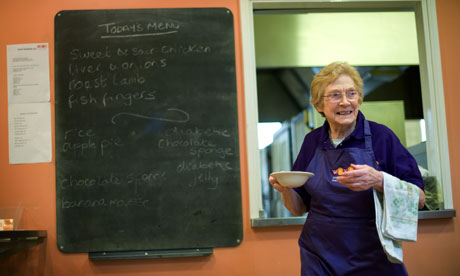
WRVS volunteer Barbara Dishley serves lunch at the Hanley Centre, Stoke-on-Trent
Debate about our ageing society is conducted typically in terms of the problems and costs of supporting growing numbers of older people. But a study published today turns that premise on its head. Far from being a burden on the economy, it says, older people are in fact net contributors.

The research, for volunteer charity WRVS, is the first to attempt to quantify the role of older generations. Taking together the tax payments, spending power, caring responsibilities and volunteering effort of people aged 65-plus, it calculates that they contribute almost £40bn more to the UK economy than they receive in state pensions, welfare and health services.

Moreover, the research suggests, this benefit to the economy will increase in coming years as the "baby boomer" cohort enters retirement. By 2030, it is projected, the net contribution of older people will be worth some £75bn.

Lynne Berry, WRVS chief executive, admits that the calculations are a first, necessarily rough, stab at assessing the value of the part played by older people in society. But she hopes that the figures will have the kind of positive impact on the public debate about the ageing society that quantifying the contribution of informal carers – currently put at £87bn gross – has had on the profile of the carers' movement since the first estimate was made in 1993.

"It was once you could put a figure on the contribution that carers made to support relatives that the whole issue of caring got that national prominence," says Berry. "We want to see the contribution made by older people really change the story from them being a drain on society to them being the most extraordinary resource."

The WRVS co-ordinates the efforts of some 50,000 volunteers who deliver meals-on-wheels, staff community clubs, run shops and cafes in hospitals and do much else besides. Many of the volunteers have retired from paid employment and it is the potential of the "younger older" to play a growing role in this way that Berry sees as a solution to the challenge posed by the pincer effect of the ageing society and the retrenchment of public services.

An ICM poll carried out for today's study found that 65% of older people say they regularly help out elderly neighbours, are the most likely of all adult age groups to do so, and that 55% of those who say they volunteer either formally or informally are members of between one and five community groups – again, more than any other age cohort.

Berry says: "The baby boomer generation is the best educated, healthiest and fittest group of younger older people this country has ever seen. All these people are now coming up to 65 and the question is, how are we going to make sure that they use their skills in their communities? It has got to be one of the 'big society' asks to grab this generation and exploit their talents as a form of social glue."

The study's calculations on the net contribution of older people have been made by economic analysts SQW. It estimates that older people benefit the economy to a total of £175.9bn, including delivering social care worth £34bn and volunteering worth at least £10bn, compared to welfare costs of £136.3bn.

By 2030, the study suggests, the estimated benefit will be £291.1bn, including almost £52bn worth of social care and £15bn through volunteering, compared to projected welfare costs of £216.2bn.

The figures and methodology have been vetted by independent experts including Robert McNabb, professor of economics at Cardiff Business School. He says that while he has some reservations about parts of the analysis, particularly the forward projection, he is sure that older people do make a net positive contribution and, indeed, suspects that the value of their caring and volunteering may have been under-rated in the study.

"People tend to be modest when they are asked how many hours they spend helping neighbours, or how long they spend volunteering at the local hospital," says McNabb. "So although the survey shows what a significant amount of time – and therefore money – is involved in these activities, I think some of these figures are really quite conservative."

Phrasal Verbs

Friday, 6 June 2014

Here's an extensive list of Phrasal Verbs on EasyPaceLearning. Please visit the site to revise.

A phrasal verb is verb with a preposition or an adverb which creates a different meaning from the original standalone verb. There are various rules and uses to them. 

- Intransitive phrasal verbs CANNOT be followed by an OBJECT. E.g. He showed up.
- Transitive phrasal verbs CAN be followed by an OBJECT. E.g. I abide by the rules.
- Some phrasal verbs can be separated (I talked her into letting me go), whereas some cannot. (The figures have been accounted for)


Phrasal Verb
Meaning
Example
Abide by
Accept or follow a decision or rule.
We have to ABIDE BY what the court says.
Account for
To explain.
They had to ACCOUNT FOR all the money that had gone missing.
Ache for
Want something or someone a lot.
My partner's been away for a fortnight- I am ACHING FOR her.
Act on
To take action because of something like information received.
The police were ACTING ON a tip from an informer and caught the gang red-handed.
Act on
Affect.
The medicine only ACTS ON infected tissue.
Act out
Perform something with actions and gestures..
They ACTED OUT the story on stage.
Act out
Express an emotion in your behaviour.
Their anger is ACTED OUT in their antisocial behaviour.
Act up
Behave badly or strangely.
My computer's ACTING UP; I think I might have a virus.
Act upon
To take action because of something like information received.
The police were ACTING UPON a tip-off.
Act upon
Affect.
The enzyme ACTS UPON certain proteins.
Add on
Include in a calculation.
You have to ADD the VAT ON to the price they give.
Add up
To make a mathematical total.
We ADDED UP the bill to check it was correct.
Add up
Be a satisfactory explanantion for something.
She explained why the work wasn't ready, but her story doesn't ADD UP.
Add up to
Have a certain result.
Trains delays are getting worse and with the high fares, it all ADDS UP TO misery for the commuters.
Add up to
Come to a certain amount or figure.
The total costs ADD UP TO several million euros.
Agree with
Affect- usually used in the negative to show that something has had a negative effect, especially is it makes you feel bad.
I feel terrible- that food didn't AGREE WITH my stomach.
Aim at
To target.
The magazine is AIMED AT teenagers.
Aim at
Intend to achieve.
They're AIMING AT reducing costs by ten percent.
Allow for
Include something in a plan or calculation.
You should ALLOW FOR delays when planning a journey.

+++ There are a lot more that I can't put on this blog. Visit the site or download the PDF version for your revision. You can easily download it into your phone or save it for offline viewing to revise on the go. There will be upcoming practices and tests on this.

Read: See seniors as part of the solution

See seniors as part of the solution 
By Rosemary Khoo AND Chiang Hai Ding Published: May 29, 4:01 AM Updated: May 29, 4:10 AM


Many seniors in Singapore, more so in the heartlands of the Housing and Development Board (HDB) than in the bungalow belt, worry about their future. Where will they live in their old age? Can they pay their medical bills? Will their Central Provident Fund (CPF) savings last their lives? Will they die alone and uncared for?

Their worries are quite remarkable because Singaporeans have among the highest per capita incomes and, through the CPF, are among the world’s biggest savers. Singapore has one of the most successful public housing programmes and one of the most effective and cost-efficient health systems. It is also quite remarkable because senior issues have, in fact, received a lot of attention from our Government and there is a lot going for seniors here.


More than 30 years ago, the first study of our ageing population was made — the Howe Yoon Chong Report in 1984, which was followed by two Inter-Ministerial Committee reports, Healthcare of the Elderly and The Ageing Population, in 1997-1998. 

In 2003, the Committee on Ageing Issues was established and in 2006, a minister in charge of ageing issues was appointed. 

So, what are the reasons for the worries of senior citizens? 

There are two. 

NOT SEEING FULL PICTURE

On the part of some movers and shakers, there is, first, an ageist way of thinking. Singaporeans’ life expectancy of 82 years is the fourth best in the world. Yet, instead of celebrating one of the successes of the Singapore Story, they bemoan the impending “silver tsunami”; seniors are regarded as a “burden”.

They point to an antiquated statistic, the “dependency ratio” of the number of working adults who supposedly support one economically useless senior. This overlooks the fact that many seniors are, in fact, asset-rich, having paid for the HDB flats that they live in.

Second, there is the unfortunate tendency towards silo thinking on ageing issues — to look at seniors as a bundle of problems that have to be tackled one at a time. While many “solutions” have been attempted, they address specific problems and fall short of looking after the whole person, the senior.

Recently, about 60 National University of Singapore (NUS) senior alumni and friends — mostly over 65 years old – met at a forum, supported by the Our Singapore Committee, to examine and help propose solutions to issues of our ageing population. 

While looking to the Government to adopt a “whole-of-government” approach and to take the lead in some areas, the senior alumni also proposed how they, and other seniors, could themselves contribute to the solution. 

VERTICAL KAMPUNGS FOR SENIORS
One starting point is the success story that is the HDB, which houses more than 80 per cent of our citizens. However, Singapore seniors have four basic needs: Housing, healthcare, money and friends. As such, retired architect Andrew Tan proposes that the HDB build “vertical kampungs” — new senior housing units based on a modular design and are located in existing HDB estates. 

Seniors could be allowed to trade-in their HDB flats for these new type of units, which could come with a basic healthcare package in the form of health promotion programmes and periodic health screening, as well as a national insurance plan which pays for medical care. 

Assuming that an old three-room flat is valued at S$400,000, and a new HDB unit at S$36,000, the participating seniors would be able to afford their healthcare and medical needs and still have spending money left over. This holistic approach would require the HDB to work with the Ministries of Finance, Health and Family and Social Development. 

Living within such an HDB community, seniors can then be enabled to seek fulfilment in meaningful social activities. These could include volunteering and lifelong learning. 

It is a myth, stressed NUS Professor of Psychological Medicine Kua Ee Heok, that people over 65 are frail and of no economic value. Research shows that many seniors are involved in community activities as volunteers in schools, libraries, museums, children’s centres, seniors’ homes and so on. Indeed, most of the participants at the session were volunteers, and they believe more could be done to create awareness of the needs of society and to equip volunteers with proper skills. 

HEALTHY IN MIND AND BODY
What also helps seniors to enrich and prolong their lives is lifelong learning. One suggestion from a group led by NUS Senior Alumni Vice-President, Mr Chua Joon Eng, was: Why not create a fund for seniors to facilitate this — CogniSave, similar in concept to MediSave, since mental health is as important as physical well-being?

Most courses offered in educational institutions here are work-related. For seniors who are more able to enjoy their leisure, there is a mishmash of courses, forums and talks offered by disparate bodies of presenters. 

One promising development last year was the start of the Singapore arm of the University of the Third Age — where there are no assignments, tests or term papers. 

It provides a space for seniors to interact and where “those who teach shall also learn, and those who learn shall also teach”.

To have peace of mind, dignity and hope in their old age, seniors should be empowered to arrange for their own healthcare costs. One participant, for example, proposed Forward Planning Health Insurance on a national basis, in which higher premiums are paid earlier during one’s working life and premiums get lower as one ages.

Ultimately, as geriatrician Carol Tan reminds us all, good health is essential to ageing with dignity and hope. “Seniors will be less fearful when they are aware that there are services available, affordable and accessible,” she added. 

Can we transform the latter years of senior citizens in Singapore into golden years? We believe we can. 

Credits: http://www.todayonline.com/commentary/see-seniors-part-solution?singlepage=true 

Vocabulary Practice 2

Wednesday, 4 June 2014

1. A person who is habitually silent or who talks very little
a) Articulate
b) Resilient
c) Taciturn
d) Unequivocal

2. A religious discourse
a) Myth
b) Sermon
c) Stanza
d) Preach

3. A large pillar made from one stone
a) Statue
b) Monolith
c) Sculpture
d) Bulwark

4. A planned route or journey
a) Travel
b) Itinerary
c) Travelogue
d) Voyage

5. Protection and immunity from extradition offered by a government
a) Dormitory
b) Sanatorium
c) Orphanage
d) Asylum

6. The existing condition or state of affairs
a) Status quo
b) Déjà vu
c) Laissez faire

7. A person who abstains from alcohol
a) Abstinent
b) Teetotaler
c) Agnomen

8. An untrained person who pretends to be a physician and prescribes drugs
a) Quack
b) Veteran
c) Glutton

9. A person who eats too much
a) Abstinent
b) Glutton
c) Omnivore
d) Reveler

10. A body of people vested with the responsibility and power to make laws for a state
a) Judiciary
b) Legislature
c) Bar
d) Constitution

Answers and Credits after jump


Vocabulary Practice

1. If you consider yourself the center of the universe, you are an …………………
a) egoist
b) egocentric
c) egomaniac

2. To have an ………………… with someone is to have a violent disagreement with them.
a) alteration
b) altercation

3. Which of the following words describes your concept of yourself?
a) ego
b) egoism
c) altruism

4. Which of the following words describes the philosophy of putting other’s welfare above one’s own?
a) egoism
b) altruism
c) magnanimity

5. Which of the following words is used to refer to the hatred of women?
a) monogamy
b) bigamy
c) misogyny

6. Which of the following words can be used to refer to the devotion to a lonely and austere life?
a) philanthropy
b) adroitness
c) asceticism

7. A person who is capable of using both hands with equal skill
a) dexterous
b) ambidextrous
c) misanthropic

8. ………………. is the custom in which one man has many wives.
a) monogamy
b) polygamy
c) bigamy

9. Which of the following words can be used to refer to the habit of spending money wastefully?
a) extravagance
b) miserliness
c) economical

10. Which of the following words can be used to refer to terse, witty and pointed statements?
a) epigrams
b) epithets
c) euphemisms

Answers and Credits after the jump

Idioms: A Collection of Values, Wise Sayings and Principles

(Suitable for all English learners. Primary Sixes will find this useful for compositions and answering the vocabulary portions of their exams, Secondary students and JC can also use these in your writing to add variety into your writing and idea presentation)


Idiomatic sayings offer you insights into a society's thinking, style and culture. They utilise figurative language to present another way of explaining things. Here's a list of idioms to learn today:


A hot potato
Speak of an issue (mostly current) which many people are talking about and which is usually disputed

A penny for your thoughts
A way of asking what someone is thinking

Actions speak louder than words
People's intentions can be judged better by what they do than what they say.

Add insult to injury
To further a loss with mockery or indignity; to worsen an unfavorable situation.

An arm and a leg
Very expensive or costly. A large amount of money.

At the drop of a hat
Meaning: without any hesitation; instantly.

Back to the drawing board
When an attempt fails and it's time to start all over.

Ball is in your court
It is up to you to make the next decision or step

Barking up the wrong tree
Looking in the wrong place. Accusing the wrong person

Be glad to see the back of
Be happy when a person leaves.

Beat around the bush
Avoiding the main topic. Not speaking directly about the issue.

Best of both worlds
Meaning: All the advantages.

Best thing since sliced bread
A good invention or innovation. A good idea or plan.

Bite off more than you can chew
To take on a task that is way to big.

Blessing in disguise
Something good that isn't recognized at first.

Burn the midnight oil
To work late into the night, alluding to the time before electric lighting.

Can't judge a book by its cover
Cannot judge something primarily on appearance.

Caught between two stools
When someone finds it difficult to choose between two alternatives.

Costs an arm and a leg
This idiom is used when something is very expensive.

Cross that bridge when you come to it
Deal with a problem if and when it becomes necessary, not before.

Cry over spilt milk
When you complain about a loss from the past.

Curiosity killed the cat
Being Inquisitive can lead you into an unpleasant situation.

Cut corners
When something is done badly to save money.

Cut the mustard
To succeed; to come up to expectations; adequate enough to compete or participate

Devil's Advocate
To present a counter argument

Don't count your chickens before the eggs have hatched
This idiom is used to express "Don't make plans for something that might not happen".

Don't give up the day job
You are not very good at something. You could definitely not do it professionally.

Don't put all your eggs in one basket
Do not put all your resources in one possibility.

Drastic times call for drastic measures
When you are extremely desperate you need to take drastic actions.

Elvis has left the building
The show has come to an end. It's all over.

Every cloud has a silver lining
Be optimistic, even difficult times will lead to better days.

Far cry from
Very different from.

Feel a bit under the weather
Meaning: Feeling slightly ill.

Give the benefit of the doubt
Believe someone's statement, without proof.

Hear it on the grapevine
This idiom means 'to hear rumors' about something or someone.

Hit the nail on the head
Do or say something exactly right

Hit the sack / sheets / hay
To go to bed.

In the heat of the moment
Overwhelmed by what is happening in the moment.

It takes two to tango
Actions or communications need more than one person

Jump on the bandwagon
Join a popular trend or activity.

Keep something at bay
Keep something away.

Kill two birds with one stone
This idiom means, to accomplish two different things at the same time.

Last straw
The final problem in a series of problems.

Let sleeping dogs lie
Meaning - do not disturb a situation as it is - since it would result in trouble or complications.

Let the cat out of the bag
To share information that was previously concealed

Make a long story short
Come to the point - leave out details

Method to my madness
An assertion that, despite one's approach seeming random, there actually is structure to it.

Miss the boat
This idiom is used to say that someone missed his or her chance

Not a spark of decency
Meaning: No manners

Not playing with a full deck
Someone who lacks intelligence.

Off one's rocker
Crazy, demented, out of one's mind, in a confused or befuddled state of mind, senile.

On the ball
When someone understands the situation well.

Once in a blue moon
Meaning: Happens very rarely.

Picture paints a thousand words
A visual presentation is far more descriptive than words.

Piece of cake
A job, task or other activity that is easy or simple.

Put wool over other people's eyes
This means to deceive someone into thinking well of them.

See eye to eye
This idiom is used to say that two (or more people) agree on something.

Sit on the fence
This is used when someone does not want to choose or make a decision.

Speak of the devil!
This expression is used when the person you have just been talking about arrives.

Steal someone's thunder
To take the credit for something someone else did.

Take with a grain of salt
This means not to take what someone says too seriously.

Taste of your own medicine
Means that something happens to you, or is done to you, that you have done to someone else

To hear something straight from the horse's mouth
To hear something from the authoritative source.

Whole nine yards
Everything. All of it.

Wouldn't be caught dead
Would never like to do something

Your guess is as good as mine
To have no idea, do not know the answer to a question

Credits to http://www.smart-words.org/quotes-sayings/idioms-meaning.html
 

Archives